
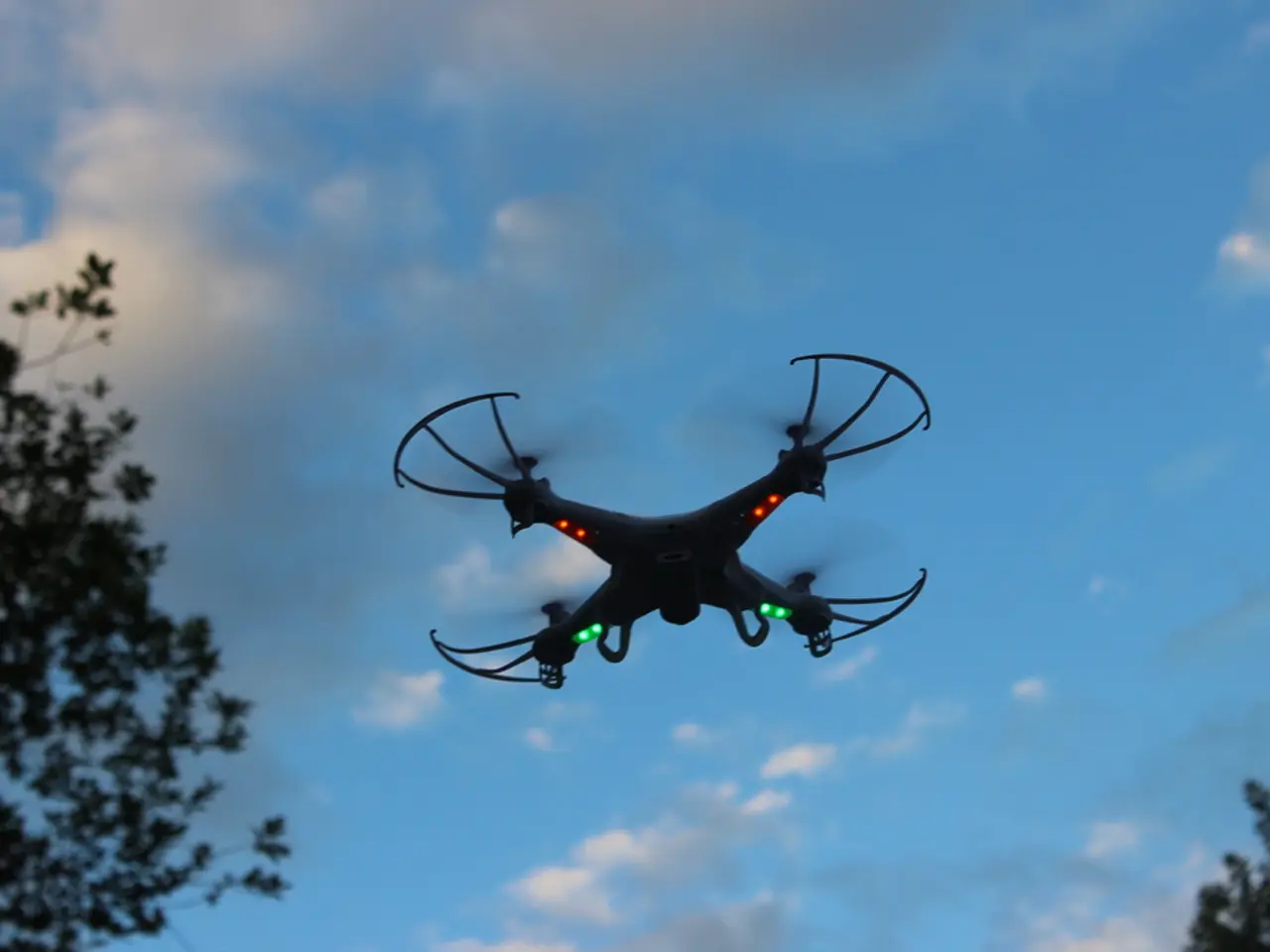
Advancements in Drone Technology: Exploring Functions, Applications, and Future Developments (2025)
In the fast-evolving world of drone technology, 2025 promises to bring significant advancements in drone software. The focus is on AI-powered autonomy, real-time adaptive flight, advanced data analytics for agriculture and industrial use, and enhanced connectivity through 5G and cloud platforms.
FlyEye's new drone software suite, designed for professionals, is set to streamline inspections and flight planning with automation, airspace checks, and weather integration. This suite is just one of many solutions shaping the future of drone operations.
DroneDeploy, a dominant player in the mapping space, continues to lead with robust photogrammetry, real-time annotations, and AI-based analysis, making it an ideal choice for construction, agriculture, and energy operators. In July 2025, DroneDeploy released AI-driven tools such as Snapshot and Safety AI, boosting operational efficiency, particularly in sectors like construction and public safety.
Precision Agriculture Software has made significant strides, with drone apps combining high-resolution aerial data, advanced sensors, and machine learning analytics. Capabilities include NDVI vegetation index mapping to assess crop health, soil mapping for nutrient and moisture analysis, elevation and terrain modeling, and integration with farm management systems for optimized irrigation, fertilization, and pest control.
Cloud-based and mobile integration is a growing trend, allowing seamless data sharing, collaboration, and on-the-go decision-making with drone-collected data linked to desktop and mobile platforms. This integration is essential for industries like construction & infrastructure, agriculture, public safety, film & media, and environmental monitoring.
Industry-specific expansion is another key trend, with drone software increasingly tailored for use in disaster relief (dynamic rerouting around obstacles), construction project management, mining, energy, and public safety, enabled by customizable, intelligent software suites.
Military applications continue to advance, with a focus on low-cost, multi-domain drone systems, reflecting ongoing innovation in drone software to support strategic operations under tight budgets.
In summary, 2025 drone software trends emphasize AI-powered autonomy, real-time adaptive flight, advanced data analytics for agriculture and industrial use, and enhanced connectivity through 5G and cloud platforms, collectively driving smarter, safer, and more efficient drone operations across sectors.
Most major platforms support DJI systems, including DroneDeploy, DroneDesk, and Pix4D. DroneDesk, a cloud-based solution, offers powerful tools for planning, compliance, client tracking, and reporting. The drone software landscape includes cloud-based platforms, desktop suites for data processing, and open-source & custom solutions.
[1] [Source] [2] [Source] [3] [Source] [4] [Source]
- In the drone software landscape, Machine Learning is increasingly being integrated into solutions for advanced data analytics, as seen in Precision Agriculture Software's use of ML analytics for tasks like crop health assessment and soil analysis.
- As the emphasis on cybersecurity continues to grow in the evolving world of drone technology, our focus should expand to include automated systems built on AI to detect and counter potential cyber threats, reflecting the ongoing need for security in technology-driven sectors.




)