
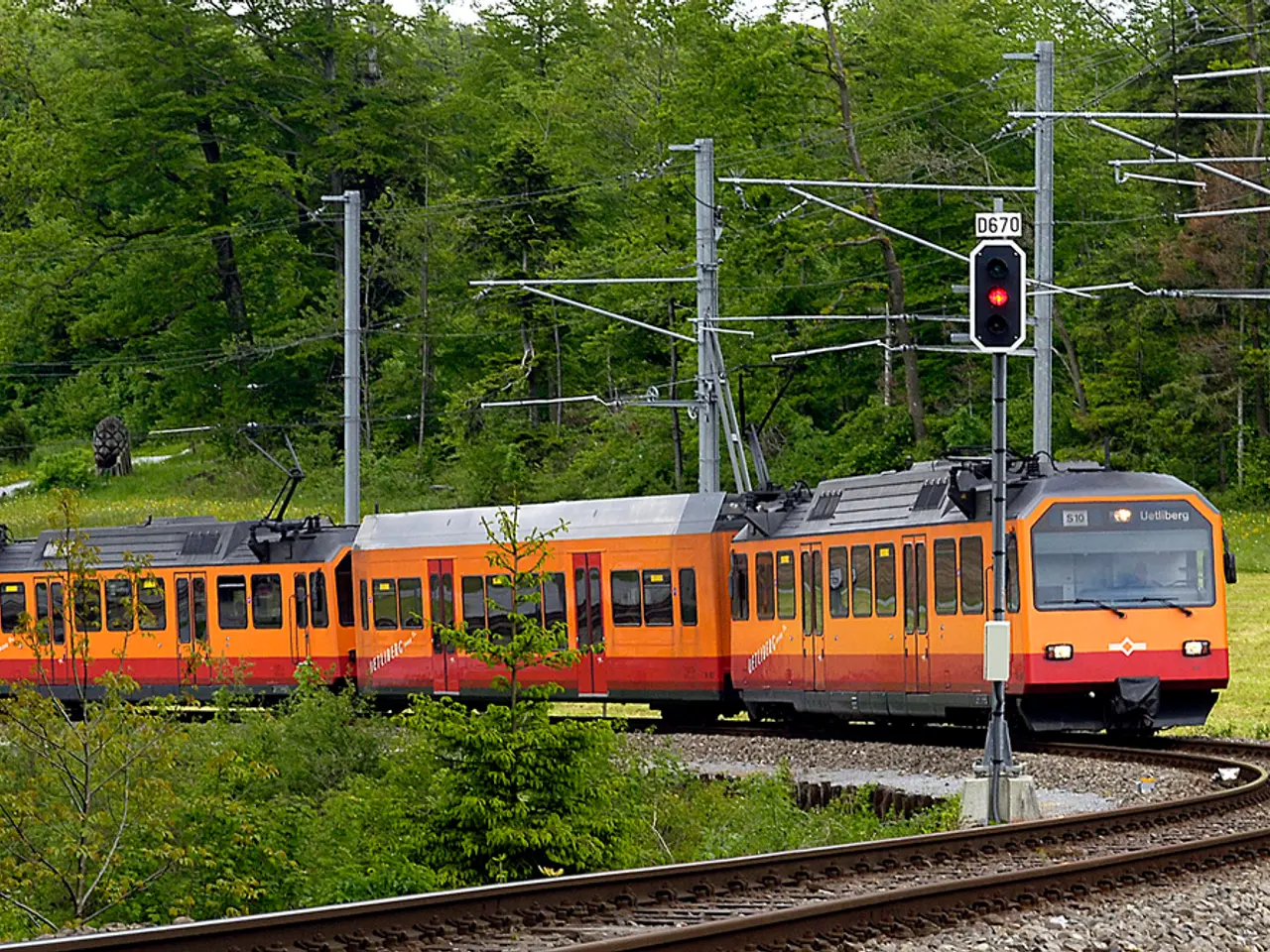
Battery-powered trains will commence operations in MV regions shortly. - Electric trains powered by batteries set to commence operations in MV soon.
Germany is gearing up for a gradual transition towards battery-powered trains, with passenger services on some battery-electric multiple unit (BEMU) routes expected to commence around spring 2026. However, the rollout faces delays primarily due to the slower completion of necessary recharging infrastructure.
Deutsche Bahn, the national railway company, is among the organizations planning to introduce battery trains. These trains will run on routes without overhead lines in various federal states, including Mecklenburg-Vorpommern. Specifically, the routes included in Deutsche Bahn's plan are between Wismar, Rostock, and Tessin, as well as between Bad Doberan, Rostock, and Graal-Müritz.
The East German Railway Company (Odeg) will also operate 14 battery trains in Westmecklenburg from the end of 2027. The state of Mecklenburg-Vorpommern is supporting the expansion with eleven million euros.
The Westmecklenburg II network, which will benefit from the introduction of battery trains, includes the routes Rehna - Schwerin - Parchim, Parchim - Hagenow Stadt, Waren (Müritz) - Malchow, and Parchim - Plau am See. The maintenance workshop in Parchim will be capable of servicing the new battery trains due to its expansion.
The Odeg maintenance workshop in Parchim is being expanded for 18 million euros and adapted to the requirements of the new battery trains. Both the East German Railway Company (Odeg) and Deutsche Bahn will receive trains from the company Stadler. The expansion of the Odeg maintenance workshop in Parchim is being funded by both the private railway company and the state of Mecklenburg-Vorpommern.
It's worth noting that battery power can be used on sections without overhead lines for battery trains. This makes battery trains an attractive option for rural or less electrified lines, as they help bridge electrified and non-electrified sections without costly infrastructure expansion.
However, no confirmed operational start dates are available yet for Mecklenburg-Vorpommern, Rostock, or other specific federal states. The general trend points to a phased introduction aligned with infrastructure upgrades, which are currently delayed and extended to 2035 in some parts of Germany.
The nationwide modernization of rail infrastructure, vital for supporting new technologies like battery trains, is facing delays. The comprehensive renovation of heavily used routes will now extend to 2035 instead of 2031, which may impact wider deployment schedules for battery trains and related services.
In other federal states, such as Schleswig-Holstein, the first battery trains are already in operation. The range of battery-powered trains, according to Deutsche Bahn, is around 100 kilometers, which could cover 80 percent of all non-electrified routes in Germany with regional trains running on battery power.
In conclusion, while battery trains are anticipated to begin passenger service in some areas as early as spring 2026, the operational start dates for Mecklenburg-Vorpommern, Rostock, and other specific federal states have yet to be confirmed. The rollout of battery trains in Germany is expected to be a gradual process, aligned with infrastructure upgrades that are currently delayed.
- The Commission may find it beneficial to consider the potential of battery technology in various industries, such as transportation (automotive) and technology, given their contribution to reducing ionizing radiation exposure risks.
- Considering the financial implications, the expansion of the maintenance workshop in Parchim to service battery trains could provide opportunities for investments in the finance sector, as the rail infrastructure modernization is a significant project.
- With the growth in battery train usage in sectors like transportation (railways), there might be a need for regulations and directives that ensure worker safety from ionizing radiation, as suggested in the proposal for a directive on the approximation of the laws of the Member States.




