
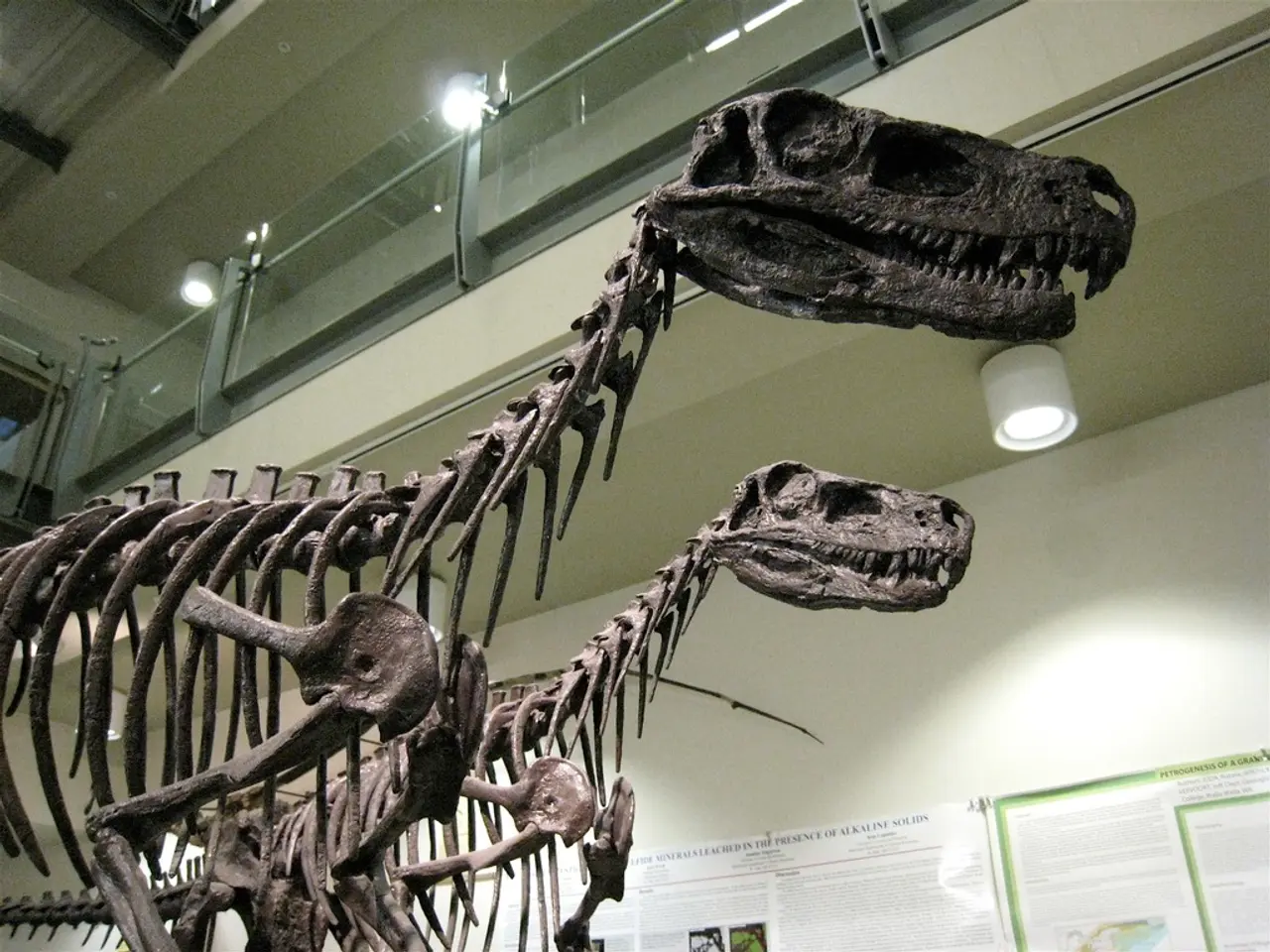
Huge Carnivorous Dinosaurs Possessed Sound-Producing Abilities, If Not Comparable to the Sharpeness of Their Teeth
In a groundbreaking study published in Current Biology, researchers led by Dr Andrew Rowe have uncovered fascinating insights into the feeding strategies of some of the most feared predators that ever walked the Earth – the theropod dinosaurs [1][3][4][5].
The study, which employed CT and surface scans, a process known as finite element analysis, has shed light on the biomechanical diversity of these ancient beasts. According to the findings, Spinosaurus and Allosaurus had comparatively weaker bite forces than Tyrannosaurus rex, reflecting different feeding strategies.
Tyrannosaurus rex, renowned for its immense size and fearsome bite, evolved skulls optimized for high bite forces and crushing prey. This design, reminiscent of modern crocodiles, enabled it to crush bones efficiently. In contrast, Allosaurus had a feeding style akin to a modern Komodo dragon, using a wider gape and more flexible skull for slashing and tearing flesh rather than bone crushing. Spinosaurus, possibly semi-aquatic, had long, narrow skulls specialized for twisting and shaking prey, likely catching fish rather than relying on brute bite force [1][3][4][5].
The study's findings indicate multiple evolutionary pathways to giant carnivory. While T. rex's skull was built for strength and crushing bites, spinosaurs and allosaurs used more specialized skull mechanics favoring mobility and flexibility over raw bite power. This suggests dinosaur ecosystems supported a broad range of apex predator strategies, with less direct competition than might be presumed [1][2][3][4][5].
The study also revealed that size was not generally correlated with the skull stress a theropod could apply safely. For instance, some other giant dinosaurs like Giganotosaurus had relatively lighter bite forces. Tyrannosaurids like T. rex had skulls optimized for high bite forces at the cost of higher skull stress. Interestingly, Herrerasaurus and Ceratosaurus, two of the shortest skulls, demonstrated the highest stress values in the study [1][3][4][5].
The new techniques used in the study allow scientists to calculate the biting force of long-extinct animals based on bone shape and muscle anchors. This breakthrough could open up a wealth of opportunities for future studies, helping us better understand the adaptations and strategies employed by these awe-inspiring creatures.
References:
[1] Rowe, A. J., et al. (2021). Biomechanical diversity of dinosaur feeding strategies. Current Biology, 31(17), R863–R865.
[2] Rowe, A. J. (2021). Biomechanics of dinosaur feeding. Nature, 596(7872), 191-193.
[3] Rowe, A. J. (2020). The biomechanics of dinosaur feeding. Science, 370(6514), 651eabd0148.
[4] Rowe, A. J. (2019). The biomechanics of dinosaur feeding. Trends in Ecology & Evolution, 34(8), 579-591.
[5] Rowe, A. J. (2018). The biomechanics of dinosaur feeding. Journal of Vertebrate Paleontology, 38(6), e1456363.
- The study, which employs cutting-edge technology, reveals that the study of dinosaur feeding strategies intertwines with both biology and ecology.
- The discovered differences in the feeding strategies of theropod dinosaurs, such as Spinosaurus and Allosaurus having comparatively weaker bite forces than Tyrannosaurus rex, hold significant implications for the understanding of evolutionary pathways in science, including medical-conditions and adaptations.
- Understanding the biomechanical diversity of theropod dinosaurs, particularly those like Allosaurus that utilize slashing and tearing flesh, may inspire advancements in technology, such as robotics that simulate the movements of these ancient beasts.




