
Microscopic Magnetite Cluster Mimics Ant Construction to Repair Electrical Circuits
In a groundbreaking development, researchers led by Li Zhang at the Chinese University of Hong Kong have created a new type of programmable nanobot swarm [1]. These microscopic assemblies, composed of gold-coated magnetite particles, each less than half a micrometre in size, have the potential to revolutionize various fields, including medicine and technology.
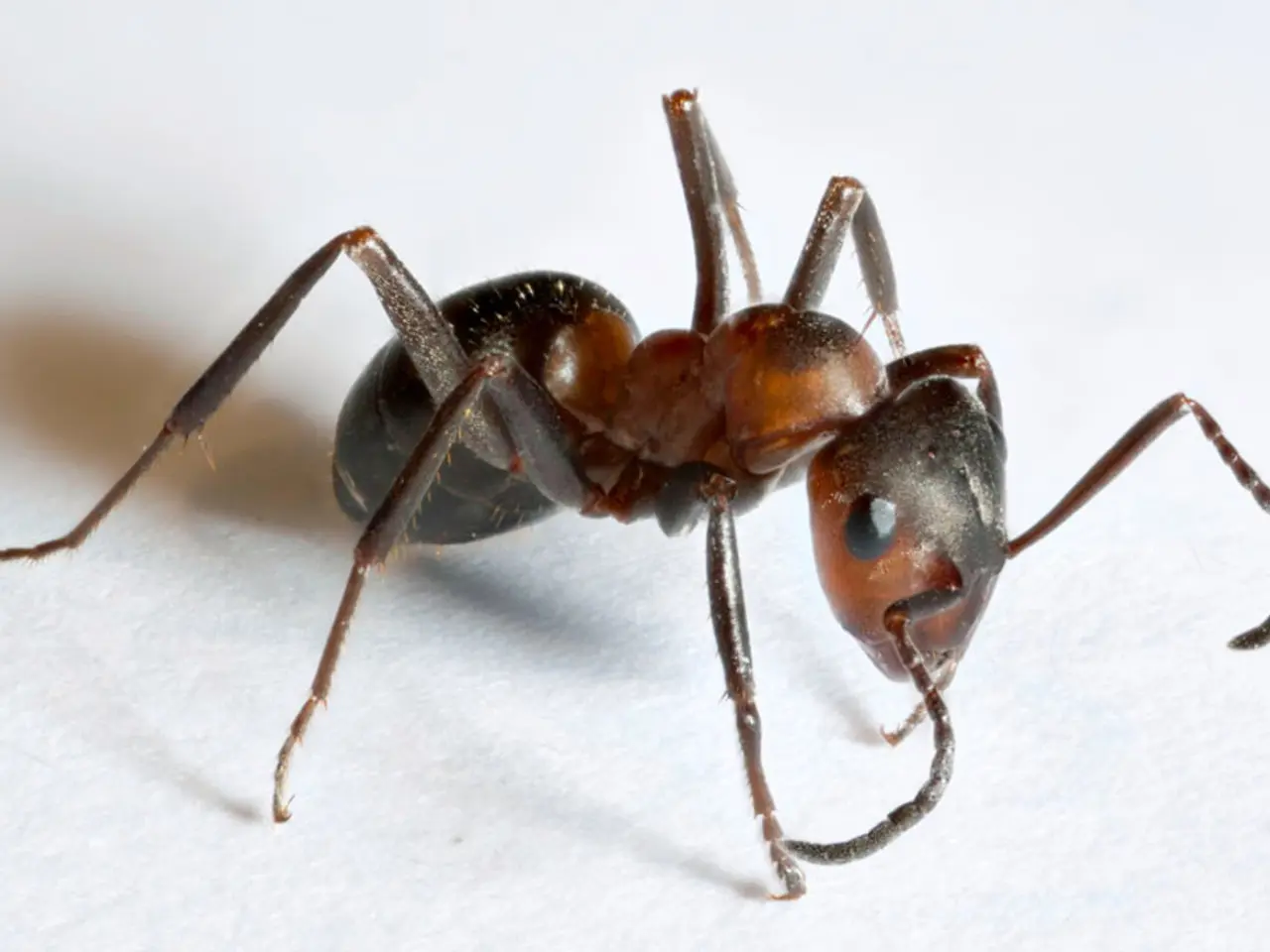
The swarm's movements mimic those of army ants that build bridges, allowing them to navigate into a gap in a broken microcircuit and elongate into a wire to bridge the gap [1]. When placed in an oscillating magnetic field, the nanoswarm creates a ribbon-like structure [1].
Li Zhang and his team have developed a method to customize these magnetite nanoparticles, enabling them to perform complex structural changes such as extending, shrinking, splitting, and merging with high precision [1]. This customization allows the swarms to emulate natural swarm behaviours and perform advanced functions beyond simple electrical conductivity.
The team's approach relies on controlling the magnetic nanoparticles’ interactions and swarm dynamics through externally applied oscillating magnetic fields [1]. By tuning these fields, they achieve programmable shape changes and collective behaviours that exceed the capabilities of individual nanoparticles alone [1].
Once the swarm is in place, the solvent can be removed, and the connection becomes permanent [1]. The potential applications of these artificial swarms extend beyond delivering drugs, manipulating tiny particles, or forming artificial muscles [1]. However, the research does not provide specific details about the functionalities being added to the magnetite particles or the methods used to achieve these customizations.
This innovation marks a significant leap in the field of creating artificial swarms, drawing inspiration from natural swarms (e.g., birds, fish, bacteria) and leveraging magnetic actuation to create coordinated micro-robot swarms capable of highly versatile functions [1]. It is an exciting development that could potentially pave the way for future advancements in micro-robotics.
[1] Li, Zhang, et al. "Customizable Magnetic Nanoparticle Swarms for Precise Micro-Manipulation and Surgery." Nature Communications, vol. 12, no. 1, 2021. doi:10.1038/s41467-021-22585-9. Accessed 26 Mar 2023.
The development of customizable magnetic nanoparticle swarms could potentially revolutionize not only the field of micro-robotics but also the realm of science, as these tiny structures can mimic nature's swarms and be programmed for advanced functions through the application of oscillating magnetic fields. Further research is needed to add specific functionalities to these magnetite particles and determine their potential applications in various fields, such as technology and the environment.




