
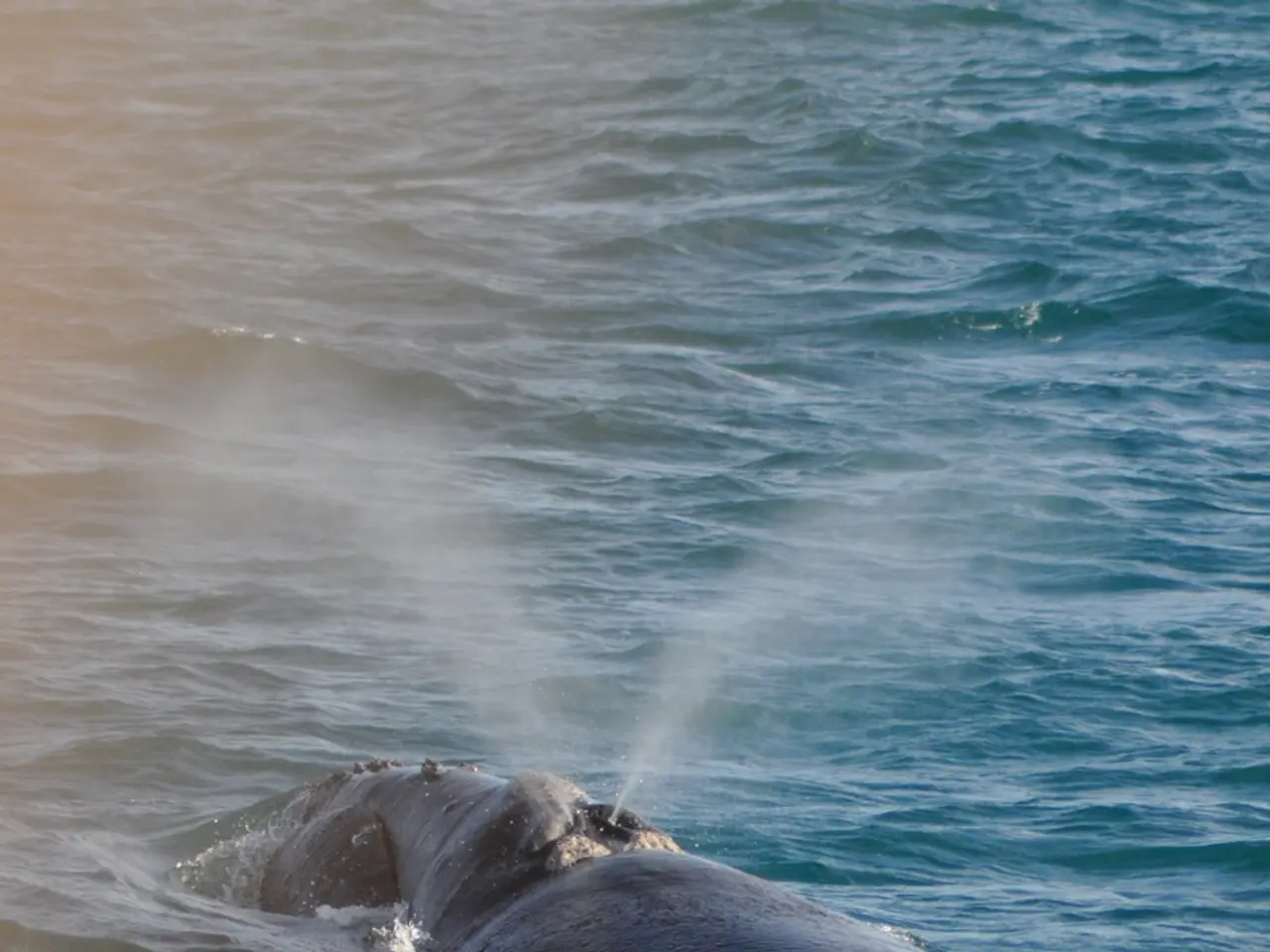
Monitoring Whale Sounds
In a groundbreaking development, artificial intelligence (AI) technology is revolutionising the study of whale communication, offering unprecedented insights into the natural world. This research, largely driven by the Cetacean Translation Initiative (Project CETI), is shedding light on the complex linguistic abilities of sperm whales [1][2][3][4].
Project CETI, a collaborative effort between oceanic research organisations and academic institutions, employs machine learning, robotics, and bio-inspired sensors to decode sperm whale vocalizations known as codas. These intricate patterns of clicks, resembling syntax, have revealed hundreds of distinct codas, signs of conversational turn-taking, and possibly dialects within whale populations. This evidence suggests that sperm whales possess a form of phonetic alphabet and are capable of social learning [1][2][3][4].
The project collects data from underwater microphones, drones, suction-cup tags, and custom gliders, enabling more precise analyses of whale communication. This rich acoustic and physiological data is fuelling a growing international discourse on granting legal personhood and stronger protection to whales based on their demonstrated intelligence and communication capacities [1][3].
In addition to scientific advancements, Project CETI collaborates with interdisciplinary groups such as the More Than Human Life (MOTH) Project at New York University School of Law. These collaborations explore the implications of these findings on animal personhood and animal rights, including discussions on granting whales legal protections that acknowledge their cognitive and social complexity, potentially leading to personhood status with rights akin to those of humans [3].
A 2025 scholarly paper argues that understanding whale communication could influence enforcement against underwater noise pollution and catalyse new laws to protect marine mammals’ well-being [3]. As AI technology continues to refine its ability to decode whale language, researchers predict rudimentary decoding by 2026, bridging biology, AI, robotics, and legal studies in a broad, interdisciplinary effort [2][3].
The international community is rallying behind this initiative, with Ocean Alliance and whale.org providing whale recordings for the project [5]. The ongoing effort to grant whales personhood aims to give them a voice, shedding light on their complex social structures and behaviours, and paving the way for a more harmonious coexistence between humans and these intelligent marine mammals.
Scientists involved in the Cetacean Translation Initiative (Project CETI) are utilizing technology, including machine learning and robotics, to decode the complex vocalizations of sperm whales, contributing to environmental-science findings about their linguistic abilities. This research, in addition to shedding light on potential social structures and dialects within whale populations, has wider implications in discussions about animal personhood and legal protections based on whale cognition and communication capacities.




