
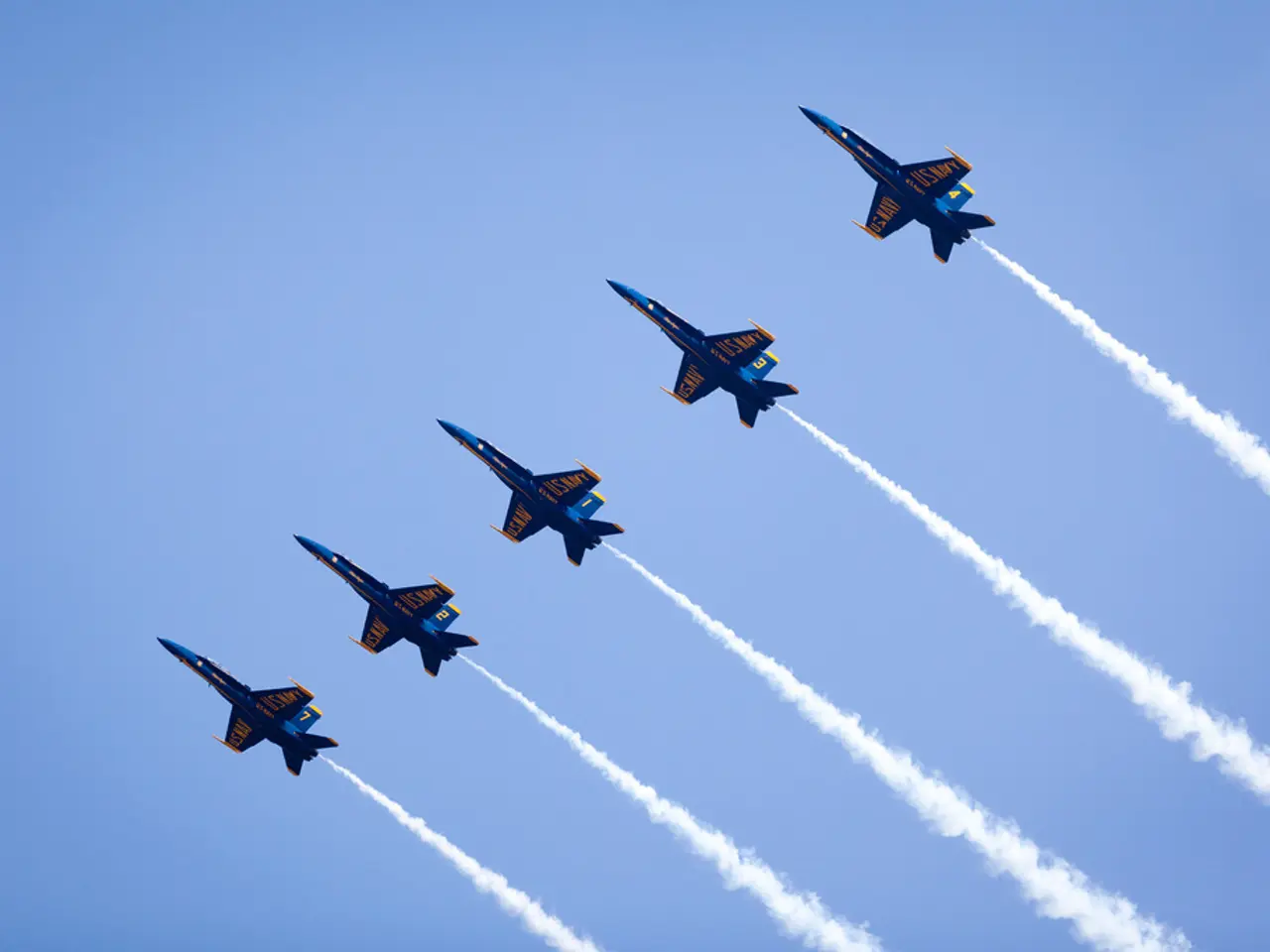
Prepared for Departure: The Potential of Green Fuel in Air Travel
The sustainable aviation fuel (SAF) market is witnessing a significant surge, with an expected Compound Annual Growth Rate (CAGR) of 47% to 54% through 2029 [1][2]. This growth is driven by increasing environmental concerns, growing demand from airlines, and stringent carbon emissions regulations.
Government mandates are playing a pivotal role in this development. For instance, the EU’s ReFuelEU Aviation mandate requires a minimum SAF blending of 2% in 2025, scaling up to 70% by 2050 [3]. Similar policies are being advanced in North America, offering long-term demand certainty for SAFs.
Investment opportunities in the sector are expanding rapidly. The sector sees robust Mergers and Acquisitions (M&A) activity, venture capital inflows, and government-backed financing focused on scaling production, supply chain integration, and innovative feedstock technologies. Major oil and gas companies are entering the SAF market, signaling rising competitiveness and potential for consolidation [2].
However, challenges remain, particularly for advanced SAF technologies. Key barriers include high capital costs, first-of-a-kind technology deployment risks, and uncertainty over offtake agreements and future prices. To overcome these, experts suggest a two-phase government policy approach: initially providing revenue certainty to de-risk investment, followed by enforceable mandates to ensure sustained demand growth [5].
Current global production capacity is limited, expected to satisfy only about 3% of aviation fuel demand by 2025 [4]. The market expansion is geographically strongest in North America, Europe, and Asia Pacific, with new production facilities and R&D investments driving growth [2][3].
Sweden, France, and the Netherlands are among the countries setting minimum quotas for SAFs, with Sweden mandating at least 0.5 percent of aviation fuel must be SAFs in 2021, France setting a minimum of 1 percent for SAFs in 2022, and the Netherlands considering a minimum quota of 14 percent by 2030 [6].
While electric propulsion in aviation may not be feasible within the next 25 to 30 years due to insufficient infrastructure and inadequate battery range, SAFs can already be used in existing tanks today and are produced from waste materials such as used cooking oils [7].
The aviation industry consumed nearly 7.5 million barrels of oil per day in 2019, representing 8% of global oil consumption [8]. Without political intervention, the industry's oil consumption could rise to over 14 million barrels per day by 2050. The World Economic Forum estimates an increase to 510 million tons by 2040 [9].
The SAF market aligns with the United Nations Sustainable Development Goals for sustainable transport, sustainable tourism, and sustainable consumption and production patterns, offering attractive investment opportunities for investors [10]. Companies like Columbia Threadneedle Investments see opportunities in the SAF market despite it still being in its infancy [11].
Sources:
[1] Global Market Insights, Inc. (2022). Sustainable Aviation Fuel Market Size, Share & Trends Analysis Report By Type, By Application, By Region And Segment Forecasts, 2022 - 2029. Retrieved from https://www.gminsights.com/industry-analysis/sustainable-aviation-fuel-market
[2] International Air Transport Association (2022). Sustainable Aviation Fuels. Retrieved from https://www.iata.org/contentassets/03b82f6c7e214181a13e83e409e0a943/sustainable-aviation-fuels-factsheet.pdf
[3] European Commission (2021). ReFuelEU Aviation. Retrieved from https://ec.europa.eu/info/strategy/priorities-2019-2024/europe-green-deal/climate-change/refuel-eu-aviation_en
[4] Airbus (2021). Sustainable Aviation Fuels. Retrieved from https://www.airbus.com/innovation/sustainability/sustainable-aviation-fuels.html
[5] International Energy Agency (2021). Sustainable Aviation Fuels: A Global Outlook. Retrieved from https://www.iea.org/reports/sustainable-aviation-fuels-a-global-outlook
[6] European Commission (2021). Sweden mandates 0.5 percent SAFs in aviation fuel from 2021. Retrieved from https://ec.europa.eu/commission/presscorner/detail/en/ip_21_3345
[7] International Air Transport Association (2022). Sustainable Aviation Fuels. Retrieved from https://www.iata.org/contentassets/03b82f6c7e214181a13e83e409e0a943/sustainable-aviation-fuels-factsheet.pdf
[8] International Energy Agency (2021). Oil Market Report. Retrieved from https://www.iea.org/reports/oil-market-report
[9] World Economic Forum (2021). Aviation Fuel Efficiency: A Roadmap for Sustainable Aviation Fuel. Retrieved from https://www.weforum.org/reports/aviation-fuel-efficiency-roadmap-sustainable-aviation-fuel
[10] United Nations (2015). Sustainable Development Goals. Retrieved from https://www.un.org/sustainabledevelopment/sustainable-development-goals/
[11] Columbia Threadneedle Investments (2021). Sustainable Aviation Fuel: A New Frontier for Investors. Retrieved from https://www.columbiathreadneedle.com/us/insights/sustainable-aviation-fuel-a-new-frontier-for-investors.html
- The sustainability of the aviation sector is being driven by advancements in technologies such as science and environmental-science, as well as government mandates focused on climate-change mitigation.
- To fully capitalize on the potential of the sustainable aviation fuel (SAF) market, government policies should consider a strategic approach that provides initial revenue certainty for innovations in SAF technologies, followed by enforceable mandates to ensure sustained demand growth.




