
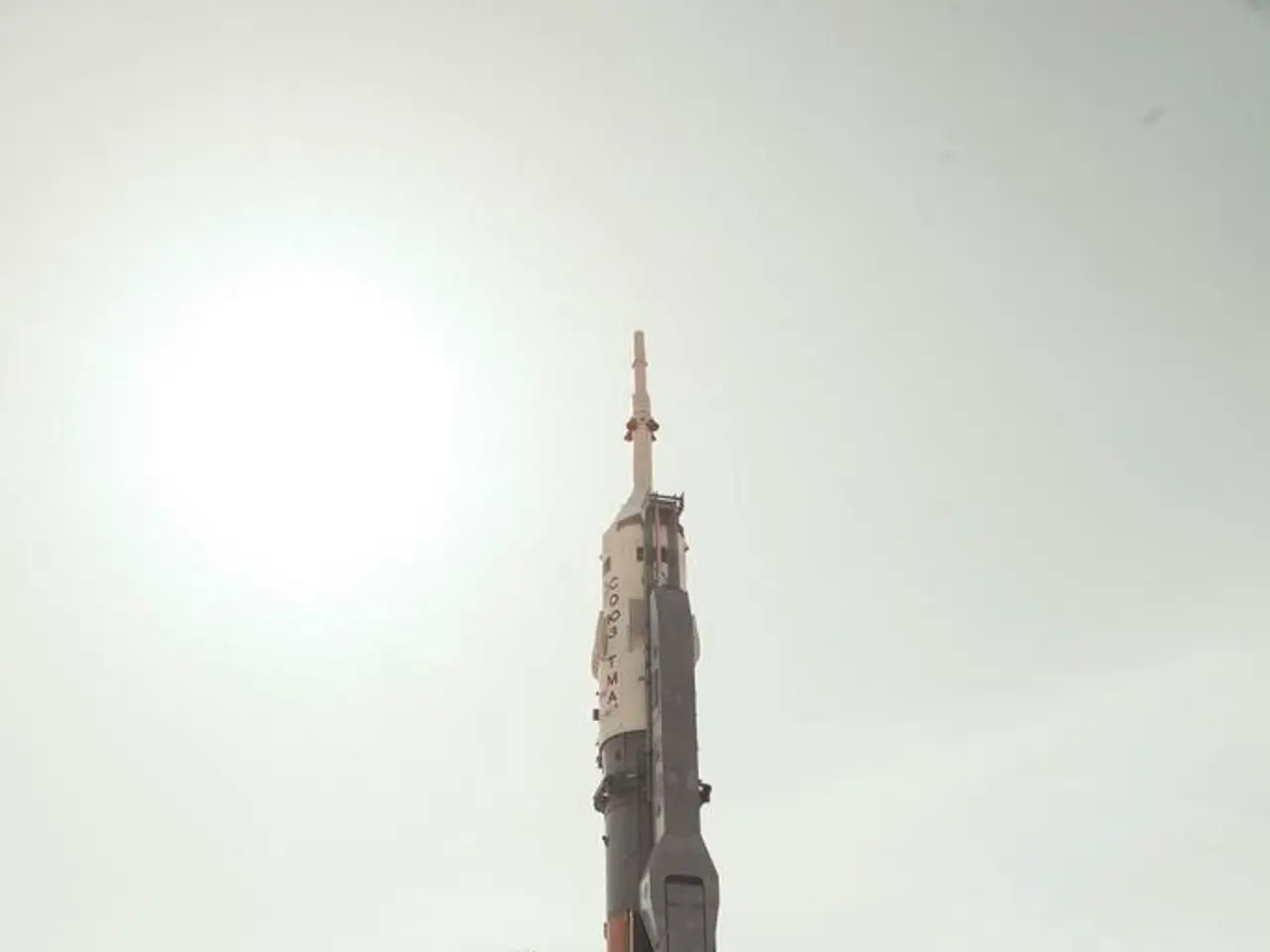
Spacecraft X-37B, belonging to the Space Force, is set to re-enter space, equipped with cutting-edge technology.
U.S. Space Force's X-37B OTV-8 Mission: Pioneering Next-Generation Space Technologies
The U.S. Space Force is set to launch the eighth test flight of its experimental spaceplane, the X-37B, on August 21 from the Kennedy Space Center in Florida. This mission, known as OTV-8, will focus on testing high-bandwidth inter-satellite laser communications and the highest performing quantum inertial sensor ever flown in space.
The laser communications demonstration will utilise commercially proliferated satellite networks in low Earth orbit, potentially including SpaceX's Starlink constellation. This technology packs more data into each transmission compared to radio frequency transmissions, improving resilience, efficiency, security, and data transport speeds in U.S. space-based communications architectures.
The quantum inertial sensor, a new addition to the X-37B's payload, measures acceleration using the principles of quantum mechanics. It enables navigation without relying on GPS, marking a significant step towards self-sufficient space travel.
The X-37B has a history of extended stays in orbit. Its seventh mission lasted 434 days before returning to Earth on March 7, 2023. Previously, it spent 780 consecutive days in orbit. The OTV-8 mission will carry a service module to expand experiment capacity and provide new opportunities for mission partners such as the Air Force Research Laboratory and Defense Innovation Unit.
In contrast, China’s Shenlong spaceplane, while also a reusable space vehicle, is less publicly documented regarding specific mission aims or technologies. Shenlong completed its third mission in late 2024 after spending 268 days in orbit. It is believed to focus more on atmospheric hypersonic flight and testing reusable space vehicle technologies.
The Space Force has recently started revealing more about the X-37B's mission objectives since it made its debut in 2010. The organisation is focusing on a faster turnaround of its reusable vehicle, aiming for multiple missions in a shorter timeframe. The upcoming mission will carry an unidentified number of payloads, furthering the X-37B's role as a testbed for advanced space technologies.
[1] Space.com [2] NASA [3] SpaceNews [4] Ars Technica
- The upcoming X-37B OTV-8 mission by the U.S. Space Force collaborates with notable technology outlets like Gizmodo to discuss the advancements in space-and-astronomy that this mission promises.
- The X-37B mission's focus on next-generation technologies, particularly inter-satellite laser communications and a quantum inertial sensor, is a significant stride forward for the field of science and technology.
- The future of space travel could involve self-sufficient journeys, thanks to advancements in technology such as the quantum inertial sensor, a key component of the X-37B's payload.
- Comparatively, while China's Shenlong spaceplane also focuses on reusable vehicle technologies, its mission aims and specific technologies remain less publicly documented than those of the X-37B, indicating a potential gap in future technology developments between the two nations.




