
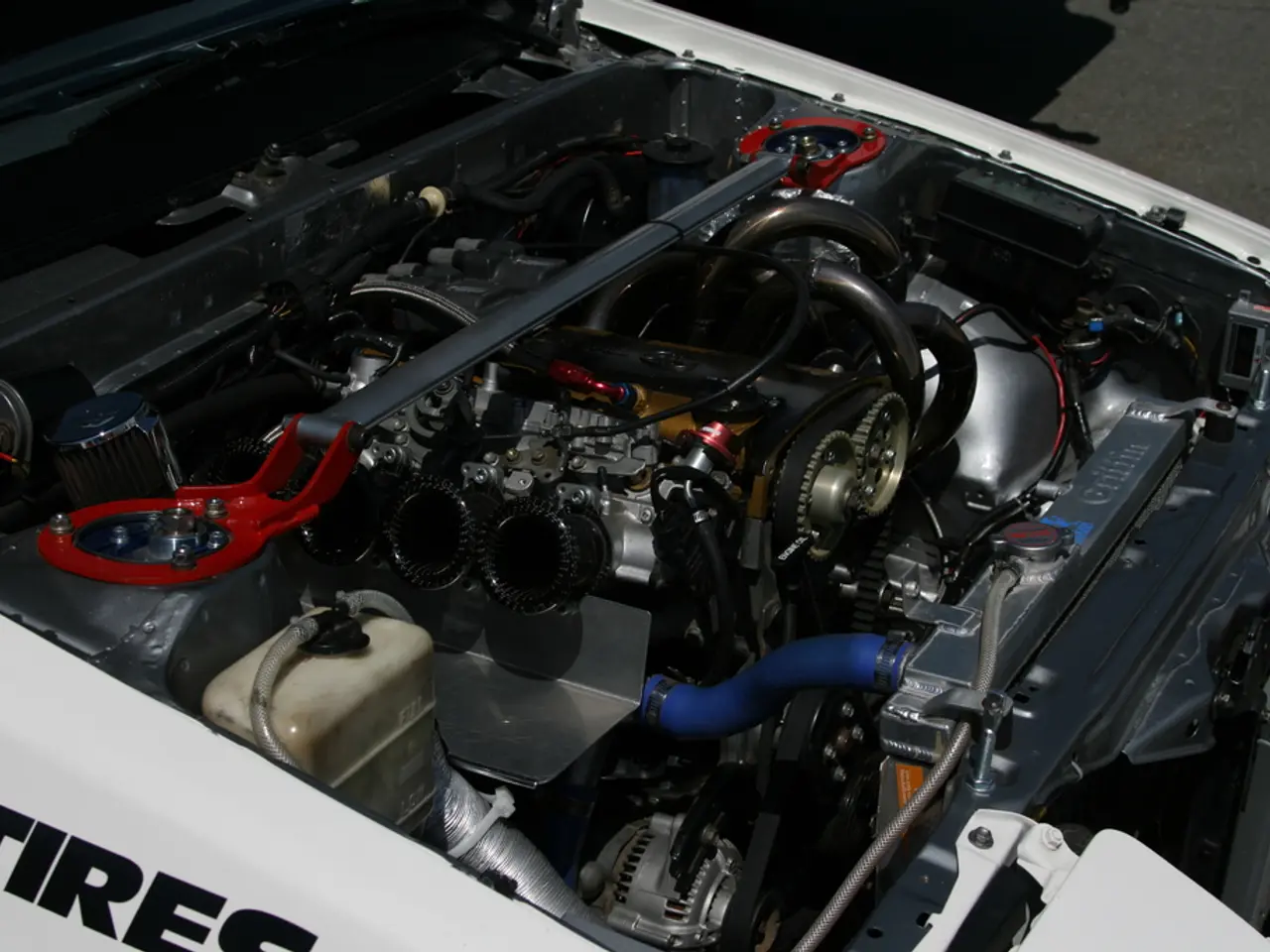
Transforming the Journey: The Advancement of Combined Energy Systems in Vehicle Engineering
Hybrid powertrains, a blend of electric motors and traditional internal combustion engines, are becoming an increasingly popular choice in the automotive industry. This technology is seen as a pragmatic approach to reducing vehicle emissions while enhancing performance.
A hybrid powertrain can take three main forms: Parallel, Series, and Plug-in Hybrids. In a Parallel Hybrid, both the engine and the electric motor can send power directly to the vehicle's transmission. In a Series Hybrid, the gasoline engine powers an electric generator, which either charges the battery or powers an electric motor that drives the transmission. Plug-in Hybrids can recharge their batteries directly from an external power source.
The efficiency and performance of these hybrid vehicles depend on the management system's ability to seamlessly switch between the electric motor and the internal combustion engine. This requires sophisticated control algorithms and software that continuously monitor driving conditions, battery charge levels, and power demands.
In the realm of advanced algorithms and machine learning models used for optimizing hybrid powertrain systems, multi-objective optimization frameworks leveraging metaheuristics such as Genetic Algorithms (GA), Particle Swarm Optimization (PSO), and Ant Colony Optimization (ACO) combined with reinforcement learning and dynamic programming form the core methods. These techniques enable efficient, adaptive, and eco-friendly operation in complex real-world scenarios.
Metaheuristic algorithms like GA, PSO, and ACO are widely used for multi-objective optimization tasks involving trade-offs between operational efficiency and ecological impact. Hybrid approaches combining metaheuristics with machine learning (ML) enhance adaptability and learning from past system behavior, enabling faster, smarter optimization in dynamic conditions. Reinforcement Learning (RL) is a key ML technique, where the hybrid powertrain can be modeled as a Markov Decision Process (MDP). The system learns optimal control policies through feedback by maximizing rewards related to emission reduction or fuel economy, updating Q-values for different state-action pairs.
Dynamic Programming (DP) is used to calculate optimal state-of-charge (SoC) trajectories minimizing cost functions in energy management strategies, such as for plug-in hybrid electric vehicles. More recent or specialized hybrid metaheuristic combinations, such as integrating novel optimization techniques with multi-view learning, are also being explored for fine-tuned governance of powertrain components.
The integration of more sophisticated AI-driven management systems in hybrid powertrains will become standard. Ongoing research into battery technology, regenerative braking systems, and more efficient electric motors is promising. This evolution will likely close the gap in performance and efficiency between conventional and electric vehicles.
The automotive industry's commitment to innovation in hybrid powertrains is a testament to its resilience. For deeper technical insights into hybrid powertrain systems and their advancements, SAE International's guide and IEEE Xplore's analysis are recommended.
However, one of the primary challenges in hybrid powertrain engineering is the physical integration of multiple power sources within a limited space. Nevertheless, the rapid advancement of AI and ML in automotive applications opens new frontiers for adaptive energy management strategies.
Hybrid powertrains offer a balance between minimizing fuel consumption and maximizing performance, making them an intriguing field of exploration and development for those passionate about automotive engineering and environmental sustainability. The author's insights on AI applications in automotive engineering are also valuable resources in this regard.
- The utilization of Genetic Algorithms (GA), Particle Swarm Optimization (PSO), and Ant Colony Optimization (ACO) in the optimization of hybrid powertrain systems aids in achieving efficient, adaptive, and eco-friendly operation.
- Reinforcement Learning (RL) is a crucial machine learning technique employed in hybrid powertrains, enabling the system to learn optimal control policies through feedback, focusing on emission reduction or fuel economy.
- Dynamic Programming (DP) is implemented to calculate optimal state-of-charge (SoC) trajectories in energy management strategies, such as for plug-in hybrid electric vehicles.
- Ongoing research into battery technology, regenerative braking systems, and more efficient electric motors in hybrid powertrains is expected to close the performance and efficiency gap with conventional vehicles.
- The combination of AI and machine learning in the automotive industry presents new possibilities for adaptive energy management strategies, addressing the challenge of integrating multiple power sources within a limited space.




